FOR CURIOUS PARENTS
An honest look at both approaches — what the research says, and how to think about what your tamariki actually needs.
Traditional schooling provides structure, peer groups, and a sequential curriculum. For many children, it works well. Forest school and nature-based programmes offer something different — not necessarily better or worse, but genuinely different in what they ask of a child and what they build in return.
This page is the comparison most parents tell us they wish they'd seen earlier: a side-by-side of how the two approaches actually differ in daily experience, plus what the research currently shows about outcomes.
It's not an argument for picking one. It's a tool for picking deliberately.
| Aspect | Traditional School | Forest School / Nature-Based |
|---|---|---|
| Who leads the learning | Teacher-directed; curriculum pre-planned | Child-led; emergent curriculum follows children's interests |
| Setting | Indoors, primarily seated | Outdoors, active, all weathers |
| Assessment | Grades, tests, formal reporting | Observation-based, qualitative; focuses on the whole child |
| Social structure | Same-age peers, large group | Mixed ages, small group, community-based |
| Risk and challenge | Largely managed out; safety focus | Managed risk encouraged; builds resilience and judgement |
| Pace | Set schedule; subjects in blocks | Unhurried; children follow their own rhythm |
| Physical activity | Limited; mainly at interval/PE | Continuous; movement is integral to the day |
The evidence for nature-based learning has grown substantially in recent years. Key findings include:
This doesn't mean traditional schooling lacks value — it doesn't. But for many children, a regular dose of nature-based learning alongside school (or instead of it) provides something important that they're not getting elsewhere.
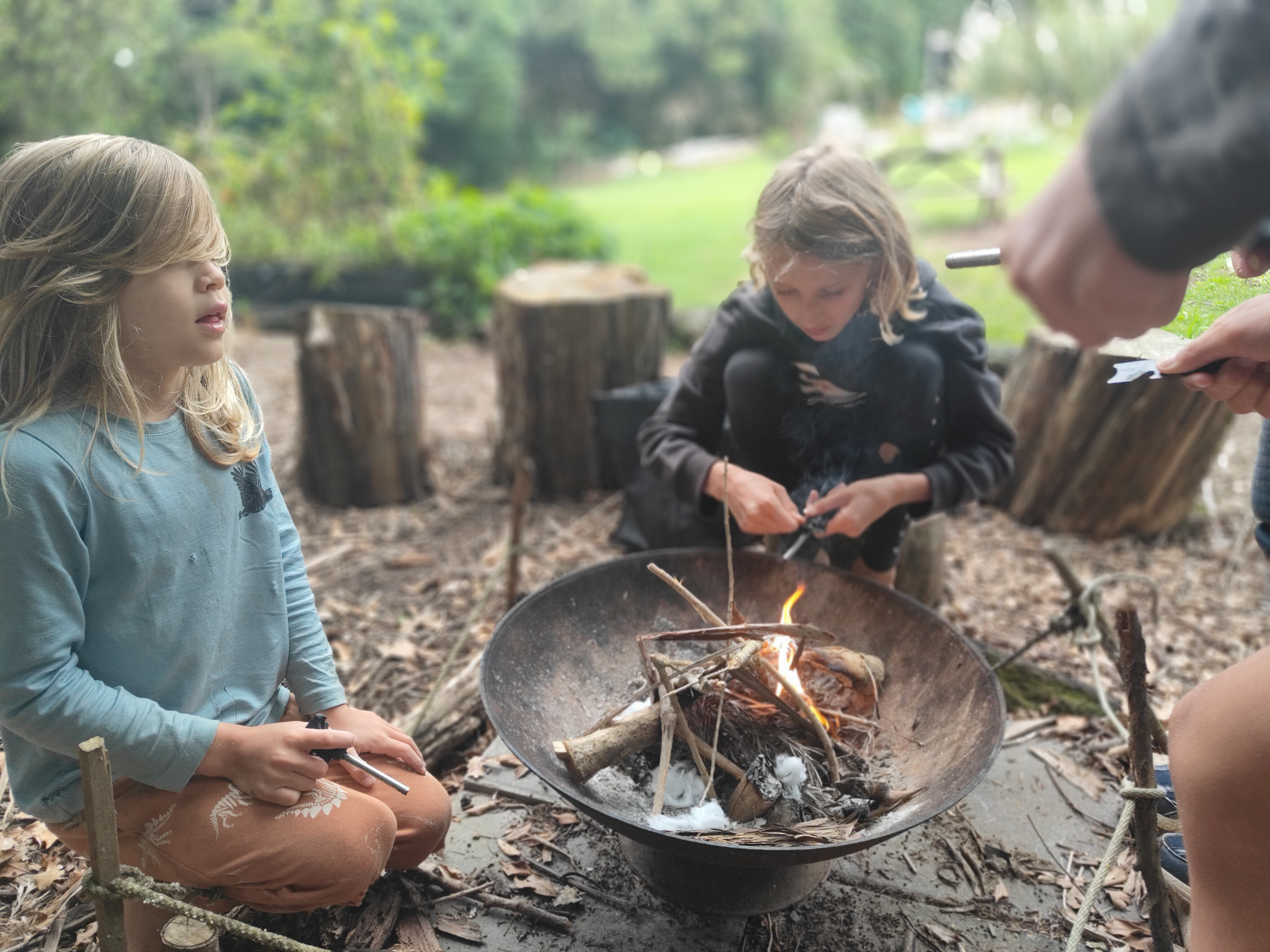
One of the things we're most proud of at The Bush Base is that we don't ask families to choose. Many of our tamariki attend school during the week and come to us on Mondays or Wednesdays. They get the structure, peer group, and curriculum of traditional schooling — and they get one day a week to move, create, and breathe in the bush.
For homeschooling families, The Bush Base provides the community, peer connection, and specialist environment that can be hard to replicate at home. It supplements, rather than replaces, whatever learning approach the family uses.
You don't have to commit to a philosophy. You just have to find what works for your child.
Enquire and arrange a try day. See for yourself what a day at The Bush Base looks like — and decide from there.
Enquire Now